Who created Pac-Man? Toru Iwatani and the small Namco team
The game is usually credited to one man, but it was a five-person effort with a very specific goal: make an arcade game that women would want to play.
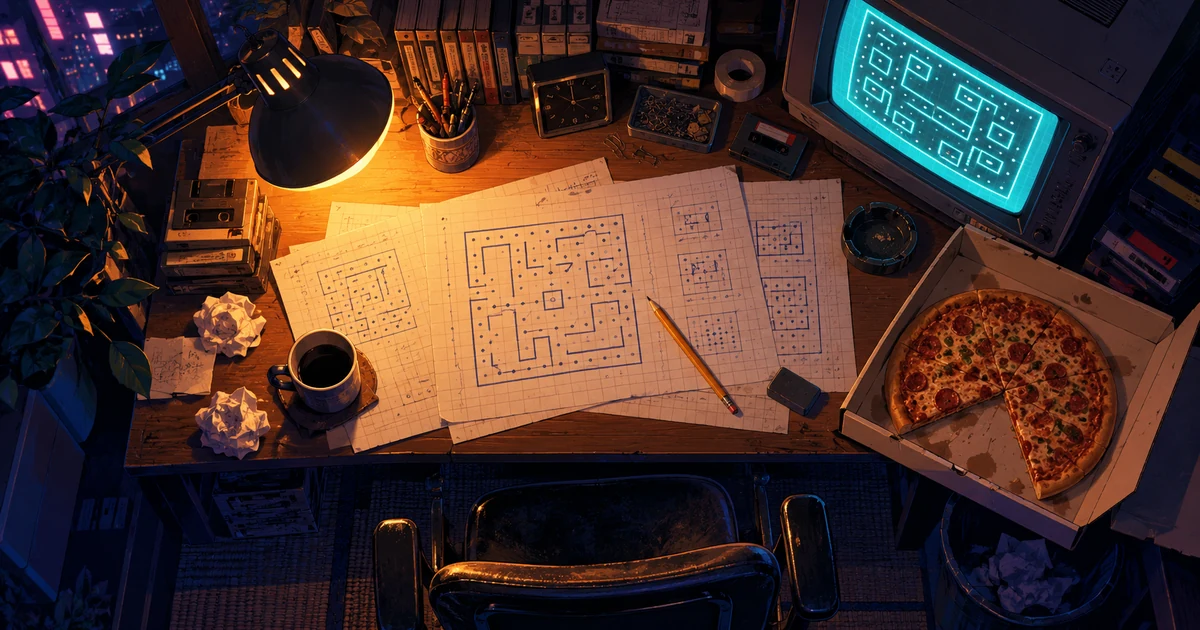
Toru Iwatani: the designer
Toru Iwatani was born in Tokyo in 1955 and joined Namco in 1977 with no formal training in programming or art. His first projects were the Gee Bee family of video pinball games, which taught him how arcade economics worked: a cabinet had to be easy to understand at a glance and leave the player wanting one more credit. By 1979 he had earned enough trust to pitch an original concept, and the one he chose was deliberately unlike anything on the floor.
Iwatani's stated aim was to make a game that appealed to women and couples. His reasoning was simple: arcades in 1979 were loud, male spaces full of shooting games, and a game built around eating and cute characters would feel welcoming. He has repeated the pizza anecdote many times, often with a smile, admitting that the story is "half true": the missing slice gave him the shape, but the Japanese kanji for mouth and the practical need for a clear eating animation mattered as much.
The rest of the team
| Person | Role | Contribution |
|---|---|---|
| Toru Iwatani | Game designer | Concept, character design, ghost personalities, difficulty tuning |
| Shigeo Funaki | Lead programmer | Movement, ghost AI implementation, speed tables, the ghost house logic |
| Toshio Kai | Sound and music | The opening jingle, the waka-waka eating sound, siren and death sounds |
| Hardware engineer | Cabinet and board | Z80-based Namco board, display and controls |
| Artist | Cabinet art | Side art and marquee for the Japanese Puck Man cabinet |
Funaki's programming is the reason the ghosts can be analysed tile by tile today: their behaviour is deterministic, which is what allows pattern play and verified perfect games. The precise targeting rules are in ghost targeting logic in pacman, and the overflow bug that gives Pinky and Inky strange behaviour when Pac-Man faces up is a quirk of that original code.
Design choices that defined the game
- Non-violent core loop. Eating replaced shooting. Even the way Pac-Man "defeats" ghosts, by eating them after a power pellet, returns them to play rather than destroying them.
- Enemies with character. Iwatani assigned each ghost a colour, a nickname and a distinct chasing rule. He has said that a single swarming behaviour would have felt oppressive, while four different ones felt like a cartoon chase. Names and nicknames are catalogued in names of the four pacman ghosts.
- Relief built into the rules. Scatter mode sends the ghosts to their corners periodically, and the warp tunnels on each side slow ghosts down, giving an escape hatch.
- Short cutscenes. Three comic intermissions reward progress and let the player relax for a few seconds.
What Iwatani did afterwards
Iwatani stayed at Namco for decades, working on titles including Libble Rabble (1983) and producing Pac-Man Championship Edition in 2007, which he described as his final game design. He later became a university lecturer in Tokyo and has spoken widely about game design as a craft of considerate rules rather than technology. He has noted with characteristic humour that he received no bonus for creating one of the best-selling games in history, since he was a salaried employee.
Common misconceptions
- "Pac-Man was made by Atari." No. Atari published the 1982 home port under licence; the game was created at Namco and distributed in the US by Midway. See why atari pacman disappointed.
- "Iwatani designed Ms. Pac-Man." No. The sequel began as an unauthorised enhancement kit by General Computer Corporation in Massachusetts, later licensed by Midway. The story is in ms pacman gameplay differences.
- "The pizza story is the whole origin." Iwatani himself calls it half true.
For the broader context of how the game went from a Tokyo office to arcades worldwide, read the complete history of pacman, or explore the rest of the free mr pacman arcade games.
From the blog
- puck man arcade rarity — Puck Man, the 1980 Namco cabinet that became Pac-Man: how it looked, how it differed from …
- is mr pacman a real game — Mr Pacman vs Ms Pacman explained: there is no official Mr. Pac-Man arcade game. Learn wher…
- how pacman patterns work — What Pac-Man patterns are, why they work (deterministic ghosts and fixed timers), how leve…
Frequently asked questions
Who is the creator of Pac-Man?
Toru Iwatani is the designer. He led a small team at Namco that included programmer Shigeo Funaki and sound designer Toshio Kai.
How old was Toru Iwatani when he made Pac-Man?
He was 24 when development started in 1979 and 25 at the Japanese launch in May 1980.
Did Toru Iwatani get rich from Pac-Man?
No. He was a salaried Namco employee and has said he received no special bonus for the game.
Is the pizza story true?
Iwatani describes it as half true: the missing slice inspired the shape, alongside the kanji for mouth and the need for a readable eating animation.
What was Iwatani's last game?
Pac-Man Championship Edition, released in 2007 for Xbox 360.