Pac-Man vs Ms. Pac-Man: every difference explained
The sequel was built by outsiders in Massachusetts, adopted by Midway and eventually embraced by Namco. It plays faster and looser than the original, and the differences go deeper than a bow.
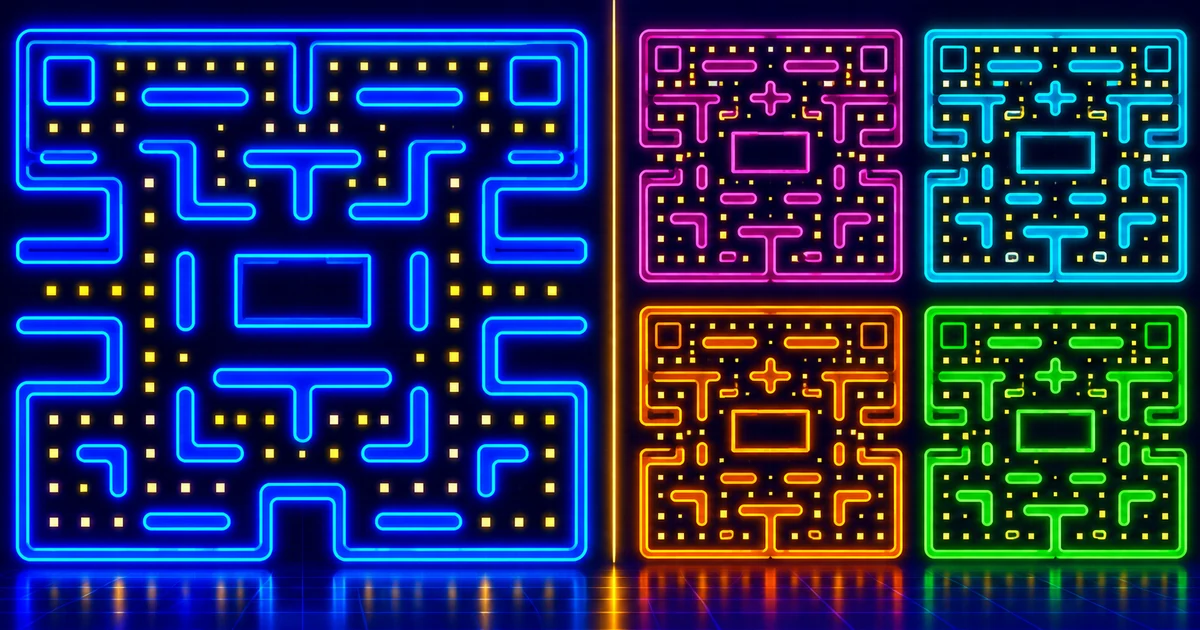
Origins: a modification kit that became a sequel
Ms. Pac-Man began as Crazy Otto, an enhancement kit created by General Computer Corporation (GCC), a group of MIT students who had previously been sued by Atari over a Missile Command speed-up kit. Midway, hungry for a sequel Namco was slow to deliver, licensed the kit, swapped the character sprites, added the bow and lipstick and released it in early 1982. Namco initially objected and later accepted it into the official canon. The broader franchise chronology is in the full pacman timeline explained.
Side by side
Pac-Man (1980)
- 1 maze
- Fixed fruit position under the ghost house
- Deterministic ghosts; patterns are reliable
- Blinky, Pinky, Inky, Clyde
- Pac-Man slower on level 1 (80%)
- Intermissions: Blinky chase sequences
- Kill screen at board 256
- Perfect score 3,333,360
Ms. Pac-Man (1982)
- 4 mazes, cycled every few boards
- Fruit bounces through the maze and exits by tunnel
- Ghosts move randomly at the start of a board and after reversals
- Blinky, Pinky, Inky, Sue
- Faster base speed
- Intermissions: the two characters meet, chase and have a baby
- Crashes inconsistently in the 130s and 140s
- High score record 933,580
The mazes
The original's single 28 by 31 maze is described in pacman maze dimensions explained. Ms. Pac-Man's four mazes are slightly different sizes, have two or more tunnels (one has four), and are coloured differently so the player always knows which is active. The first maze is used for boards 1 and 2, the second for 3 to 5, and the third and fourth alternate in pairs of boards after that. Because tunnels are more numerous, escapes are easier but patterns are far less valuable.
The ghosts
Three of the four ghosts keep their original targeting rules, but GCC added randomness: for the first few seconds of a board and immediately after each scatter-chase reversal, ghosts choose directions at random. That small change breaks the long patterns that make a perfect original game possible (see pacman ghost ai explained). Sue replaces Clyde, with identical logic; she was recoloured purple in some later versions.
Fruit
Instead of appearing in one spot, fruit enters through a tunnel, bounces around the corridors and leaves through another tunnel if not eaten. Values are cherry 100, strawberry 200, orange 500, pretzel 700, apple 1,000, pear 2,000 and banana 5,000; from board 8 the fruit is random. Compare the original's fixed schedule in pacman fruit list.
Speed and difficulty
Ms. Pac-Man runs faster from the first board and ramps earlier, so new players lose lives sooner, but the randomness means that a lost life rarely comes from an unlearned pattern. Experts generally regard the original as the deeper competitive game and Ms. Pac-Man as the better casual game, which is why bars and restaurants kept Ms. Pac-Man cabinets for decades.
Scoring and records
Dots, pellets and ghost values are identical to the original, so the scoring logic in pacman point values table applies, with the fruit table above. Because the game is non-deterministic, there is no perfect score; the recognised record is 933,580 points, discussed in pacman world records.
Verdict
| Player type | Recommendation |
|---|---|
| Beginner | Ms. Pac-Man: more forgiving of individual mistakes and more variety |
| Pattern learner or record chaser | Pac-Man: the only version with verified perfect games |
| Short sessions on a phone | Either via official collections, or the free original maze games on the mr pacman games and guides |
For the common confusion about which game is "Mr Pacman", read is mr pacman a real game.
More from the guides
- advanced pacman strategy — Pac-Man strategy for higher scores: cornering, ghost grouping before power pellets, patter…
- arcade terms for pacman players — A Pac-Man glossary: cornering, Cruise Elroy, energizer, frightened mode, ghost house, kill…
- complete pacman games timeline — A dated list of every official Pac-Man game: arcade originals, Ms. and Jr. Pac-Man, Pac-La…
Frequently asked questions
Who made Ms. Pac-Man?
General Computer Corporation created it as the Crazy Otto kit; Midway published it in 1982 under licence.
How many mazes does Ms. Pac-Man have?
Four, compared with one in the original.
Does Ms. Pac-Man have a kill screen?
Not a consistent one; the game becomes unstable around boards 134 to 142 depending on the cabinet.
Which is harder, Pac-Man or Ms. Pac-Man?
Ms. Pac-Man is faster and less predictable; the original is harder to play perfectly because perfection requires memorised patterns.
Is Clyde in Ms. Pac-Man?
No. The orange ghost is named Sue.