Pac-Man patterns explained: how memorised routes beat the ghosts
A pattern is a route you can run with your eyes closed. It works because the ghosts, the timers and the maze never change, and it is how every perfect game has been played.
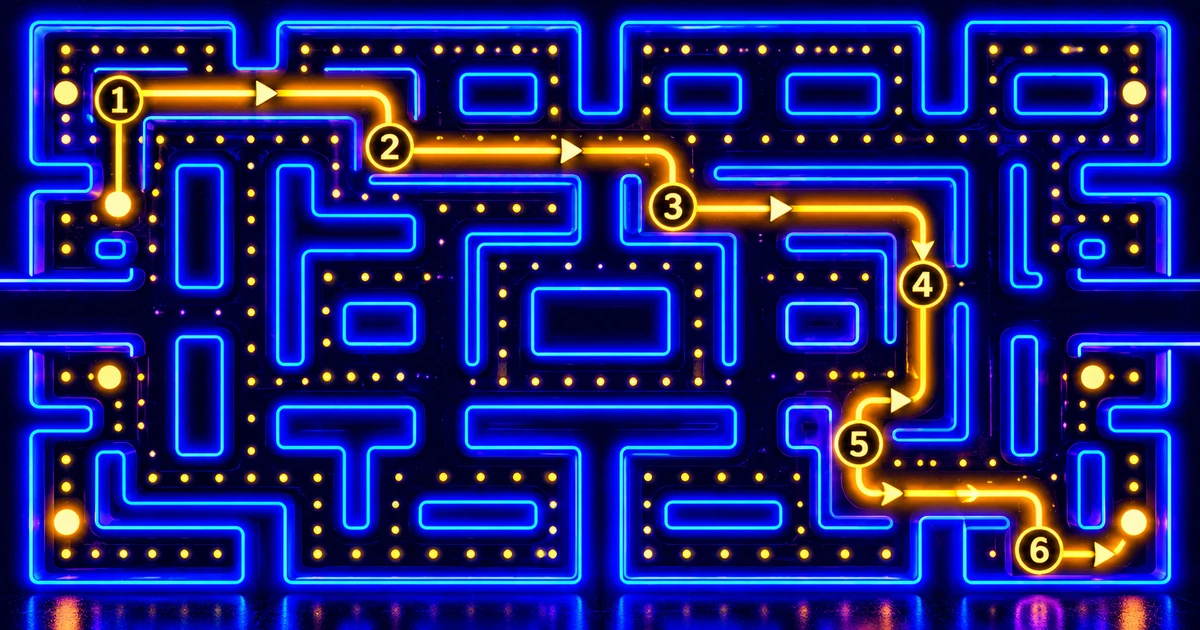
What a pattern is
A pattern is a fixed sequence of joystick inputs that clears a board without ever reacting to the ghosts. Because the ghosts choose directions by a deterministic rule (explained in pacman ghost behavior patterns), the scatter and chase phases run on fixed timers, and the maze is identical on every board, the same inputs at the same moments produce the same ghost positions every time. Run the route exactly and the ghosts are always where the route expects them.
Why one pattern covers many levels
Speeds, timers and frightened durations change by level group, not by individual level. Levels 1, 2 to 4, 5 to 20 and 21 to 255 each behave as a block (the speed values are in how fast pacman moves). A pattern tuned for level 21 therefore works unchanged on 235 consecutive boards, which is what makes a three-and-a-half-hour perfect game physically possible. The early boards need their own routes because frightened time and Cruise Elroy thresholds differ.
Where patterns break
- Deaths. Dying resets ghost positions and the dot counters that release them, so the route no longer matches. Pattern players usually abandon the pattern for the rest of the board and improvise.
- Frightened mode randomness. Blue ghosts move pseudo-randomly, so a pattern that eats a power pellet must either avoid relying on ghost positions afterwards or exploit the fact that the random generator is itself deterministic within a board.
- Imprecise inputs. A turn executed a few frames late changes Pac-Man's position relative to the ghosts and the whole sequence drifts.
- Different hardware. Bootleg speed-up kits (see pacman speed up chip) change Pac-Man's speed, so arcade patterns do not transfer.
Learning your first pattern
- Pick a level group. Level 1 is slowest and most forgiving.
- Memorise the opening: most routes clear the lower-left area first because Clyde loiters there, as his profile in clyde the orange ghost explains.
- Run it on a faithful arcade emulation until the ghosts appear in the same place each time. If they do not, your inputs are early or late.
- Add the power pellets last, timing each so at least three ghosts are grouped, using the techniques from advanced pacman strategy.
Patterns versus reading the board
Patterns make the original game a test of memory and precision. The randomised ghosts of Ms. Pac-Man were introduced specifically to defeat them, and the random mazes in the games on the mr pacman arcade guides do the same: there, reading ghost personalities matters more than memorisation. Both skills are worth having.
More from the guides
- meaning of the pacman name — Why is Pac-Man called Pac-Man? The name comes from paku-paku, Japanese for munching. It la…
- pacman energizer explained — How Pac-Man power pellets (energizers) work: 50 points, where the four are, frightened tim…
- origin story of pacman — The complete history of Pac-Man: Toru Iwatani's 1979 design at Namco, the May 1980 Japanes…
Frequently asked questions
Do Pac-Man patterns really work?
Yes, on the original arcade code. The ghosts and timers are deterministic, so identical inputs give identical results.
Is there one pattern for the whole game?
Nearly: levels 21 to 255 share one pattern. Earlier level groups need their own routes.
Do patterns work on Ms. Pac-Man?
No. Its ghosts move randomly at the start of each board and after reversals, which is why it has no perfect score.