Pac-Man Championship Edition vs the original: what changed
Toru Iwatani's last design kept the characters and the dots and threw out almost everything else: no lives to lose slowly, no fixed maze, no 256th board. A comparison of two games 27 years apart.
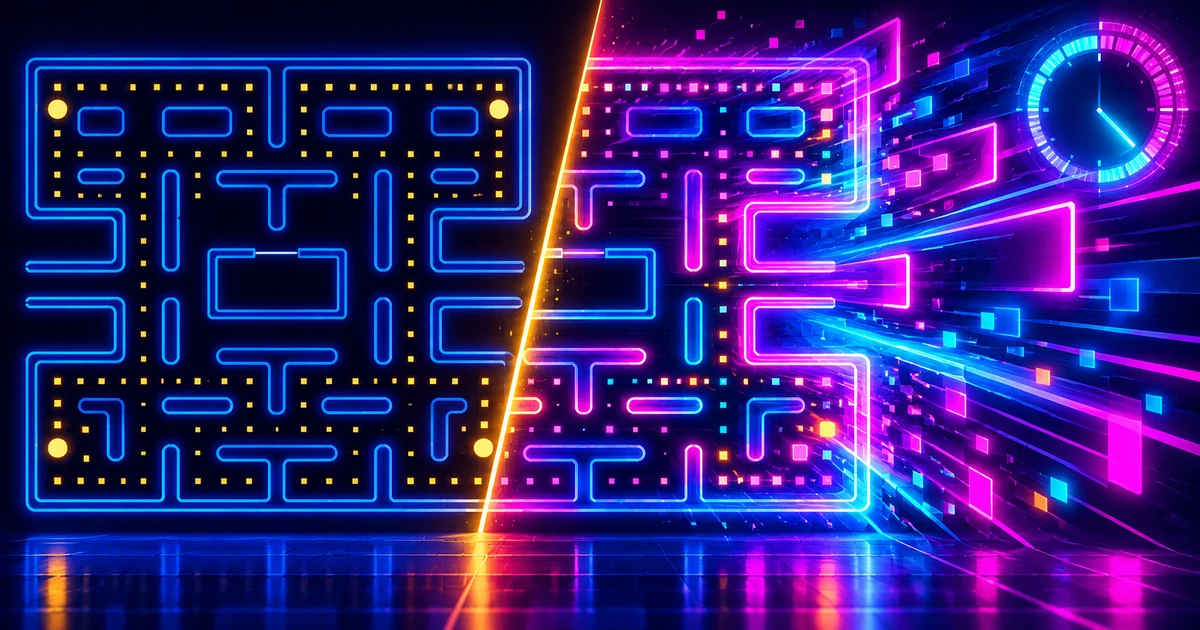
Background
Released on Xbox Live Arcade in June 2007, Pac-Man Championship Edition was produced by Toru Iwatani as his final game before leaving Namco Bandai to teach. The sequel Championship Edition DX (2010) refined the formula and is widely considered the definitive version; CE 2 followed in 2016. Iwatani's career is covered in the man who designed pacman.
Side by side
Original (1980)
- Play until lives run out
- One static maze
- Fruit scores points
- Ghost chain resets at each pellet
- Speed fixed per level group
- Game breaks at board 256
- Perfect score possible
Championship Edition (2007)
- Timed sessions of 5 or 10 minutes
- Maze split into halves; eating fruit regenerates the empty half
- Fruit refreshes the maze instead of merely scoring
- Chain continues across pellets while ghosts stay blue
- Speed rises continuously within the session
- No level cap; no kill screen
- Score-per-session records on online leaderboards
How a session works
You clear dots on one half of the maze. When that half is empty a fruit appears on the other side; eating it fills the first half with a new layout. The game is therefore a continuous loop of clearing and regenerating, and the pressure comes from the clock rather than from a dwindling stock of lives. Pellets still turn ghosts blue, but because chains persist, a well-timed sequence of pellets can produce a dozen consecutive ghost kills, with values far beyond the original's 1,600 cap described in pacman points per dot.
What DX added
- Sleeping ghosts. Dozens of dormant ghosts line the corridors; passing them wakes them and they follow in a train. Eating a pellet then lets you devour the whole train for enormous points.
- Bombs. A limited supply of bombs sends all ghosts back to the house, at a cost to speed.
- Slow-motion near collisions. When a ghost is about to touch you the game briefly slows, giving a chance to react.
- Multiple mazes and visual themes, including retro arcade styles.
Ghost behaviour
The four named ghosts keep recognisable personalities but the deterministic targeting of the original (see pacman ghost behavior patterns) is less important, because the constantly regenerating maze makes patterns impossible. Skill shifts from memory to routing: choosing the order in which to clear dots so that the fruit, pellets and ghost trains line up.
Which should you play?
| If you value | Choose |
|---|---|
| Historical accuracy and verified records | Original, via Pac-Man Museum+ or Arcade Archives |
| Short, intense sessions with a visible score target | Championship Edition DX |
| Learning the fundamentals | Original first, then DX; the tips in proven pacman scoring strategies transfer |
Our own Time Attack mode on the visit mr pacman online borrows the clock-based idea: a timer, bonuses for clearing boards and no lives to protect. Try time attack maze mode for a free taste of the format.
More from the guides
- pacman terminology explained — A Pac-Man glossary: cornering, Cruise Elroy, energizer, frightened mode, ghost house, kill…
- pacman rules for beginners — How to play Pac-Man: the goal of each board, controls, what dots, power pellets, fruit and…
- pacman perfect score — The Pac-Man perfect score is 3,333,360: every dot, pellet, ghost and fruit on 255 boards p…
Frequently asked questions
Who designed Pac-Man Championship Edition?
Toru Iwatani, the designer of the original, produced it as his final game in 2007.
Is Championship Edition timed?
Yes. Standard sessions last five or ten minutes.
What is the difference between Championship Edition and DX?
DX adds sleeping ghosts that form trains, bombs, slow-motion near collisions and more mazes.
Does Championship Edition have a kill screen?
No. There is no level counter to overflow.
Can you get a perfect score in Championship Edition?
No. Scores are per session and the leaderboard is open-ended.